
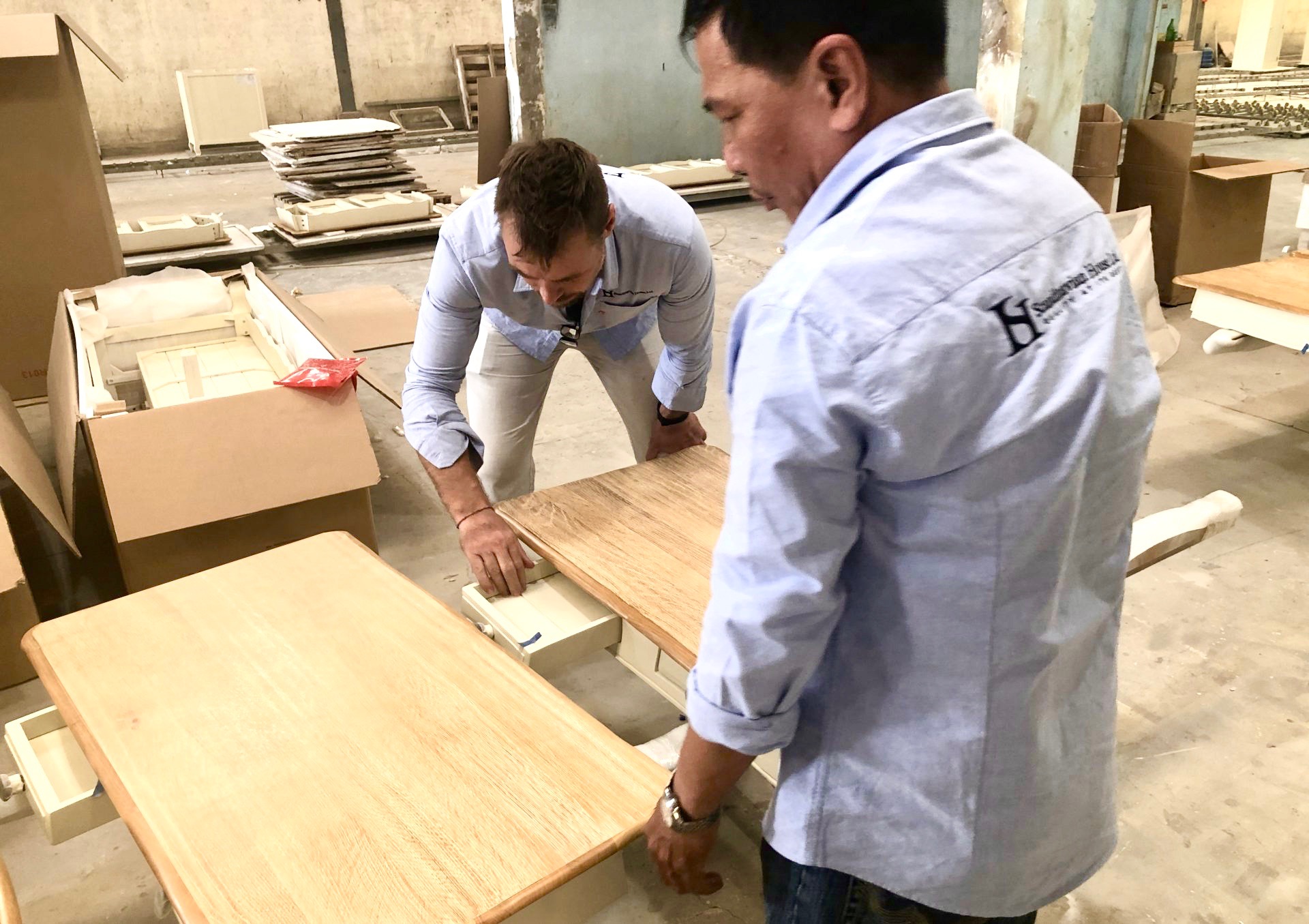
ASIACOMMERCE - A furniture sample can look excellent while the mass-production shipment arrives with different materials, unstable construction, or inconsistent finishing.
This gap makes quality control one of the most important parts of sourcing furniture from China.
Furniture presents risks that buyers cannot manage through product photos or supplier quotations alone.
Wood moisture, joint strength, hardware, upholstery, coating, dimensions, packaging, and manufacturing consistency can all affect the finished product.
Problems can also emerge after production.
Wood may crack or warp when environmental conditions change during international transportation.
Weak packaging can damage an otherwise compliant product before it reaches the destination warehouse.
International buyers therefore need quality controls throughout the sourcing process.
Supplier verification should establish whether the factory has the capabilities promised during negotiation.
Production specifications should define what the factory must manufacture.
Inspections should then verify whether finished goods actually match those specifications.
Pre-shipment inspection creates an important final checkpoint before products enter international logistics.
The destination market should also influence testing and product requirements before production begins.
Our AsiaCommerce sourcing team has managed supplier coordination, factory verification, quality control, and cross-border supply chains since 2016.
The objective is not simply to find a competitive furniture manufacturer.
It is to build a repeatable production process that delivers the product buyers actually approved.
Written by the AsiaCommerce Sourcing Team — B2B cross-border procurement and distribution specialists operating under PT Exim Jaya Abadi and PT Kalimas Mitra Perkasa since 2016. Last updated: September 2026.
Start Furniture Quality Control Before Mass Production
Furniture quality control should begin with the supplier rather than the finished shipment.
Buyers should first confirm that the supplier represents its manufacturing capabilities accurately.
A factory audit can verify the company's legal identity, production facilities, equipment, workforce, capacity, and quality management practices.
For solid-wood furniture, buyers should investigate how the factory manages wood drying and moisture.
Factories with internal kiln-drying capabilities may offer greater visibility over this critical production stage.
However, equipment alone does not guarantee proper moisture management.
The audit should examine how the factory measures, records, and controls materials throughout production.
Buyers should also establish detailed specifications before placing a bulk order.
Material requirements should identify the approved wood, MDF, HDF, plywood, metal, fabric, foam, or other components.
Metal furniture can require controls for material thickness and coating specifications.
(ALSO READ: Indonesia Medical Device Registration: A Market Entry Guide for Foreign Manufacturers)Upholstered products need approved fabric references, foam requirements, and stitching standards.
Color specifications should use measurable references or approved master samples whenever possible.
Dimensions should also include agreed tolerances rather than approximate expectations.
Construction requirements should define critical joints, screws, dowels, adhesives, brackets, and load-bearing components.
These specifications become the benchmark for later inspections.
Buyers should also understand which processes occur inside the factory and which processes are subcontracted.
Unexpected subcontracting can introduce new materials or manufacturing conditions that were never evaluated during supplier selection.
AsiaCommerce can support supplier negotiation, factory audits, and quality control as one connected China sourcing process.
This approach makes the supplier accountable to defined requirements before production reaches the inspection stage.
Inspect Materials, Construction, Finishing, and Hardware
A furniture inspection should examine much more than whether the product looks similar to the approved sample.
Material verification comes first because substitutions can significantly affect durability and appearance.
Inspectors can verify whether wood panels, fabrics, metals, coatings, and other components match approved specifications.
Dimensions should then be measured against approved drawings and tolerance requirements.
Small dimensional errors can create serious problems for knock-down furniture or products designed for specific spaces.
Construction also deserves physical testing.
Inspectors can check joint strength across screws, dowels, adhesives, brackets, and other structural connections.
A wobble test on a level surface can quickly expose unstable tables, chairs, or cabinets.
Finishing requires equally close inspection.
Paint, veneer, and laminate surfaces should remain consistent and free from unacceptable bubbles, scratches, dust contamination, or peeling.
Color shading across separate components can make assembled furniture look inconsistent even when every part remains functional.
Hardware should operate correctly.
Drawer slides, hinges, hydraulic mechanisms, locks, bolts, and assembly components should match the approved specification.
Missing hardware packs create another common customer problem for knock-down products.
Upholstered furniture introduces additional checkpoints.
Inspectors should examine stitching, loose threads, fabric tension, foam consistency, symmetry, and overall workmanship.
Common mass-production problems include inaccurate drilling, weak brackets, defective coatings, peeling veneer, rust-prone hardware, and poor upholstery finishing.
Buyers should classify these problems before inspection instead of negotiating acceptable quality after defects appear.
Clear inspection criteria create objective acceptance decisions.
They also give factories a stronger production target than general instructions such as “same quality as sample.”
Control Wood Moisture and Use Pre-Shipment Inspection
Wood moisture deserves special attention because furniture can change after leaving the factory.
Wood naturally responds to environmental humidity.
An inappropriate moisture level can contribute to cracking, warping, swelling, or mold during storage and international transportation.
The correct target should reflect the wood species, construction, manufacturing process, and expected destination environment.
The supporting sourcing data provided for this article identifies commonly referenced ranges around 6–9% for some indoor applications and up to approximately 12% in tropical conditions.
However, buyers should not treat one percentage as a universal requirement for every furniture product.
(ALSO READ: How to Import Food Products into Indonesia: BPOM, Halal, and Labeling Requirements)Specifications should define an appropriate moisture target before production.
Inspectors can then use calibrated moisture meters at selected locations during quality checks.
Moisture testing should form part of a broader pre-shipment inspection.
PSI typically occurs when most production has been completed and sufficient goods are available for representative sampling.
Inspectors randomly select units rather than allowing the supplier to present only preferred samples.
They can then conduct visual, dimensional, functional, assembly, moisture, and packaging checks.
Sampling plans can use AQL principles under standards such as ISO 2859-1 when appropriate.
Critical, major, and minor defects should have separately defined acceptance criteria.
A protruding sharp component or structural safety failure deserves different treatment from a small cosmetic scratch.
The inspection specification should reflect that difference.
Buyers can also define product-specific functional tests.
A chair may require stability and assembly checks.
A cabinet may require repeated drawer and door operation.
A table may require stability, dimensions, and load-related checks.
Pre-shipment inspection therefore provides evidence for a commercial decision before dispatch.
It works best when combined with earlier supplier verification and production controls rather than used as the only quality checkpoint.
Match Testing and Packaging to the Product and Destination
Furniture testing requirements depend on the product category and destination market.
International buyers should therefore identify relevant standards before mass production.
Office seating may be evaluated against standards such as ANSI/BIFMA X5.1 or applicable EN requirements.
Tables and desks can have different stability, strength, and durability requirements.
Storage furniture can require particular attention to structural stability and tip-over risks.
Outdoor furniture introduces additional exposure to weather, corrosion, and material degradation.
Not every standard applies to every product or destination.
Buyers should determine the required standard according to product use, target market, customer requirements, and applicable regulation.
Testing should therefore become part of product development rather than an afterthought before shipment.
Packaging deserves the same planning.
Furniture can experience stacking pressure, vibration, impact, humidity, and repeated handling during international logistics.
Carton specifications should match product weight, dimensions, and distribution conditions.
Corner protection can reduce impact damage to vulnerable furniture edges.
Internal protection should prevent components from moving and rubbing against each other.
Knock-down products also need complete hardware kits and clear assembly instructions.
Drop testing can help evaluate whether packaged products can survive expected handling conditions.
ISTA procedures may be relevant depending on the product and logistics scenario.
Ocean freight introduces another significant risk.
Temperature changes can create condensation inside shipping containers, sometimes called container rain.
Moisture-sensitive furniture therefore needs an appropriate packaging and container moisture-control strategy.
Desiccants, protective wrapping, ventilation decisions, and container condition should be selected according to shipment characteristics.
A passed factory inspection cannot compensate for packaging that fails during a multi-week international journey.
Quality control should protect the product until it reaches the destination, not merely until the factory closes the carton.
Source Furniture for Southeast Asian Market Expansion
The destination market should influence sourcing decisions before the factory starts production.
(ALSO READ: 7 Produk Fashion China yang Potensial Dijual di Indonesia, Margin Reseller Masih Menarik?)Indonesia, Malaysia, and the Philippines do not apply one universal furniture compliance framework.
Requirements can differ according to material, furniture type, intended use, sustainability claims, and commercial channel.
Wood legality and traceability deserve particular attention for timber-based furniture.
Technical standards can also become relevant for specific product categories.
Commercial buyers may additionally require international performance standards even when those standards are not universal legal requirements.
A hotel project can have different specifications from a marketplace seller.
Corporate office furniture can face different testing expectations from residential products.
Children's furniture introduces additional safety considerations.
Buyers should therefore avoid asking only whether a Chinese supplier can “export to Southeast Asia.”
The better question is whether the supplier can manufacture and document the exact product required by the intended destination and sales channel.
AsiaCommerce connects this destination planning with sourcing execution.
Our team can support supplier verification, negotiation, factory audits, and quality control in China.
We also support market-entry coordination for businesses expanding into Indonesia, Malaysia, and the Philippines.
After market entry, AsiaCommerce can support warehousing, marketplace fulfillment, and local e-commerce distribution across these markets.
AsiaCommerce operates legally under PT Exim Jaya Abadi and PT Kalimas Mitra Perkasa.
This structure supports an end-to-end model from China sourcing to Southeast Asian market execution.
Furniture buyers should therefore treat quality control as a supply-chain system rather than one inspection appointment.
The strongest process connects supplier capability, specifications, production, testing, packaging, inspection, and destination requirements.
If your furniture supplier is ready for mass production but these controls remain unclear, verification should happen before the shipment leaves China.
📲 Consult your China furniture sourcing requirements via WhatsApp: +62 877-7704-7097 (*)
AsiaCommerce: Cross-Border Supply Chain Enabler for Southeast Asia
0 Comments